
Fighting the Hydra - Systems of Power
Introducing the real drivers of civilization's evolution

“Power tends to corrupt, and absolute power corrupts absolutely.”
– Lord Acton
I want to begin with a simple image because it captures something essential about how people, including you and me, respond to change. It is said that a frog placed into hot water will leap out immediately. In contrast, a frog placed in cool water that is slowly heated will supposedly remain, adjusting as the temperature rises, until it is too torpid to escape. Whether the story is literally true is beside the point. What matters is that the pattern it describes is certainly true for humanity: we adapt to small, gradual changes, while large, sudden change triggers alarm.
That same dynamic plays out in the world around us, where shifts in power, culture, and control rarely announce themselves as a crisis. Instead, they present themselves as minor inconveniences, reasonable compromises, or temporary measures, each easy to accept on its own, yet together capable of catching us by surprise before we even realize what has happened.
Institutions rarely collapse or transform in a single dramatic event. They strain, adapt, and realign as deeper forces shift beneath the surface, often long before the signs become obvious to those absorbed in daily life. What we see happening in the world around us is following that recurrent pattern.
This series of articles sprang from a simple observation: that most people do not understand what actually drives change in the world. Our attention naturally gravitates toward individuals, movements, and events because they are visible, emotional, and easy to personalize. Leaders dominate headlines, while elections, crises, and protests create the impression that history turns on personalities and events. Yet these are not the true engines driving change. Like a marionette show, we are absorbed in the dancing figures and do not see the hands controlling them, let alone the strings.
The unseen drivers of human civilization are the systems of power we as humans have created over time to solve real needs. These systems have shaped incentives, rewarded certain behaviors, suppressed others, and continue functioning regardless of who appears to be in charge at any given moment. Confusing the actors with the play is one of the most persistent errors people make when trying to understand why societies change or appear structured as they are. It leads to repeated surprise when removing a leader, dismantling an institution, or defeating a movement fails to produce lasting results.
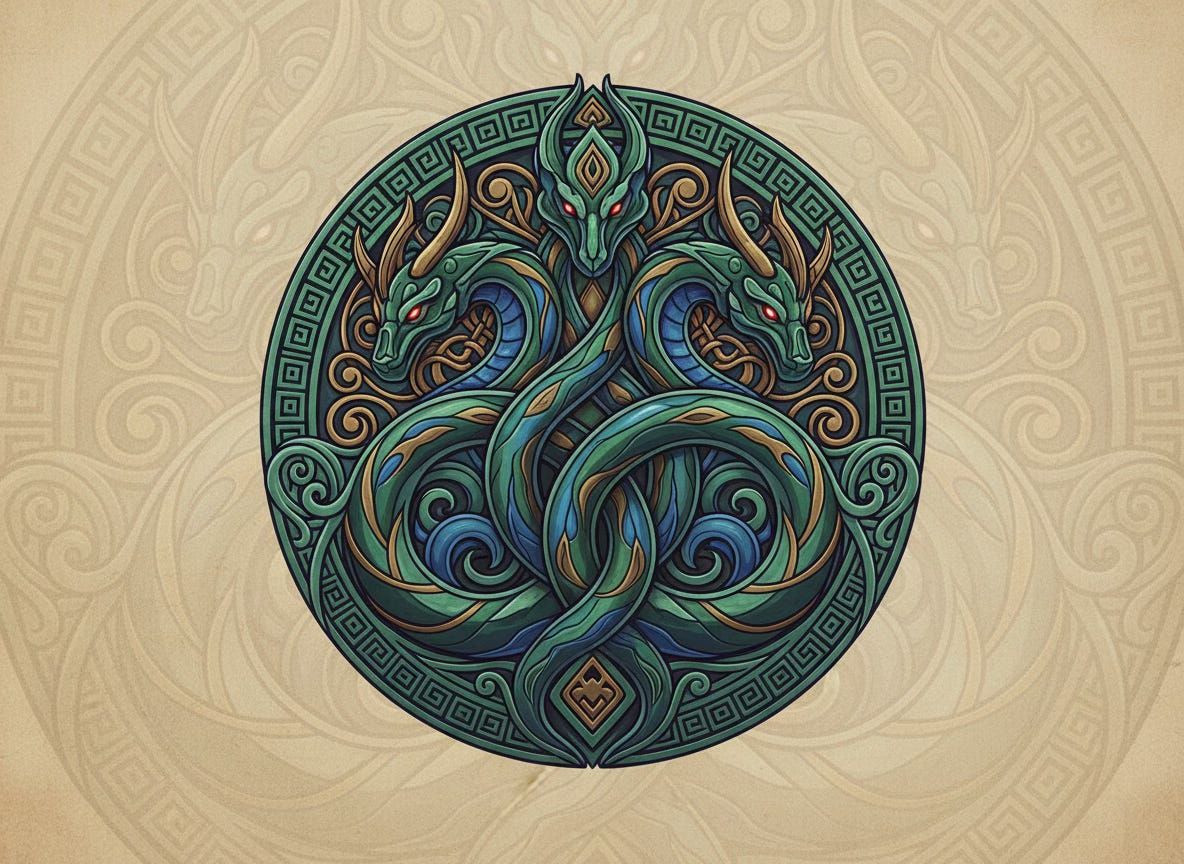
The myth of the Hydra from Greek mythology perfectly illustrates this dynamic. In the myth, cutting off one head of the Hydra would only lead to two more growing back in its place. The creature survived because its core structure was untouched. The same pattern appears wherever humans build systems to organize beliefs, people, or resources. These systems persist not because they are inherently malicious, but because they serve, at least initially, real human needs that do not disappear when one visible form is removed.
Religion (belief) provides meaning by explaining the world and our place within it, offering shared narratives that bind communities together. Governance (control) provides stability by organizing behavior, resolving conflict, and reducing uncertainty as societies grow larger and more complex. Commerce (resources) organizes and provides the goods and services that enable our survival at scale. These systems cannot simply be abolished without giving rise to new ones, because the fundamental needs they serve do not go away.
The real danger lies not in the existence of these systems, but in their corruption. Because they are built and led by human beings, they are vulnerable to the same weaknesses that afflict all human endeavors. Ambition, fear, pride, and the self-interest of their leaders slowly reshape structures that once served the many into tools that benefit the few who control them. As Lord Acton observed, power corrupts, and this corruption applies not only to individuals but to the institutions they inhabit and eventually dominate.
Left unchecked, these systems will drift from service to control, from coordination to coercion, and from necessity to exploitation. What once provided meaning becomes dogma. What once offered stability becomes coercion. What once provided value becomes extraction. These shifts rarely announce themselves loudly. They accumulate gradually, protected by habit, inertia, and the assumption that tomorrow will probably resemble yesterday.
This series of articles is not an argument for destroying these systems, nor is it a defense of them. It is an attempt to make them visible. Recognition is the first step toward addressing an issue, because without it, no response is possible. Once a system can be seen clearly, societies and individuals alike can better determine whether it is possible to redirect it back toward its original purpose if it has drifted, or replace it if not.
History shows that this process unfolds in familiar stages. When corruption is limited, and legitimacy remains, reform remains possible. When reform is blocked, and power hardens, resistance follows, often unevenly and at increasing cost. Only when resistance fails, and a system proves incapable of correction, does revolution emerge, not as an abstract ideal, but as a reluctant conclusion drawn from repeated failure. These responses are not inventions of theory. They are patterns repeated again and again, across the whole of recorded history, not the least of which is in the founding of the United States itself.
My objective is not to provide you with a step-by-step guide on how to defeat the Hydra, as the Hydra cannot be defeated. Instead, I hope to help you in the coming articles identify the Hydra’s manifestations and comprehend its objectives, so that you will be better equipped to reform it where possible, resist it when necessary, and avoid wasting time railing against a person or institution when the problem is the system that created it and its competitors.