
Defending the West: The Sword of God
Chapter 8 - The Sword of God

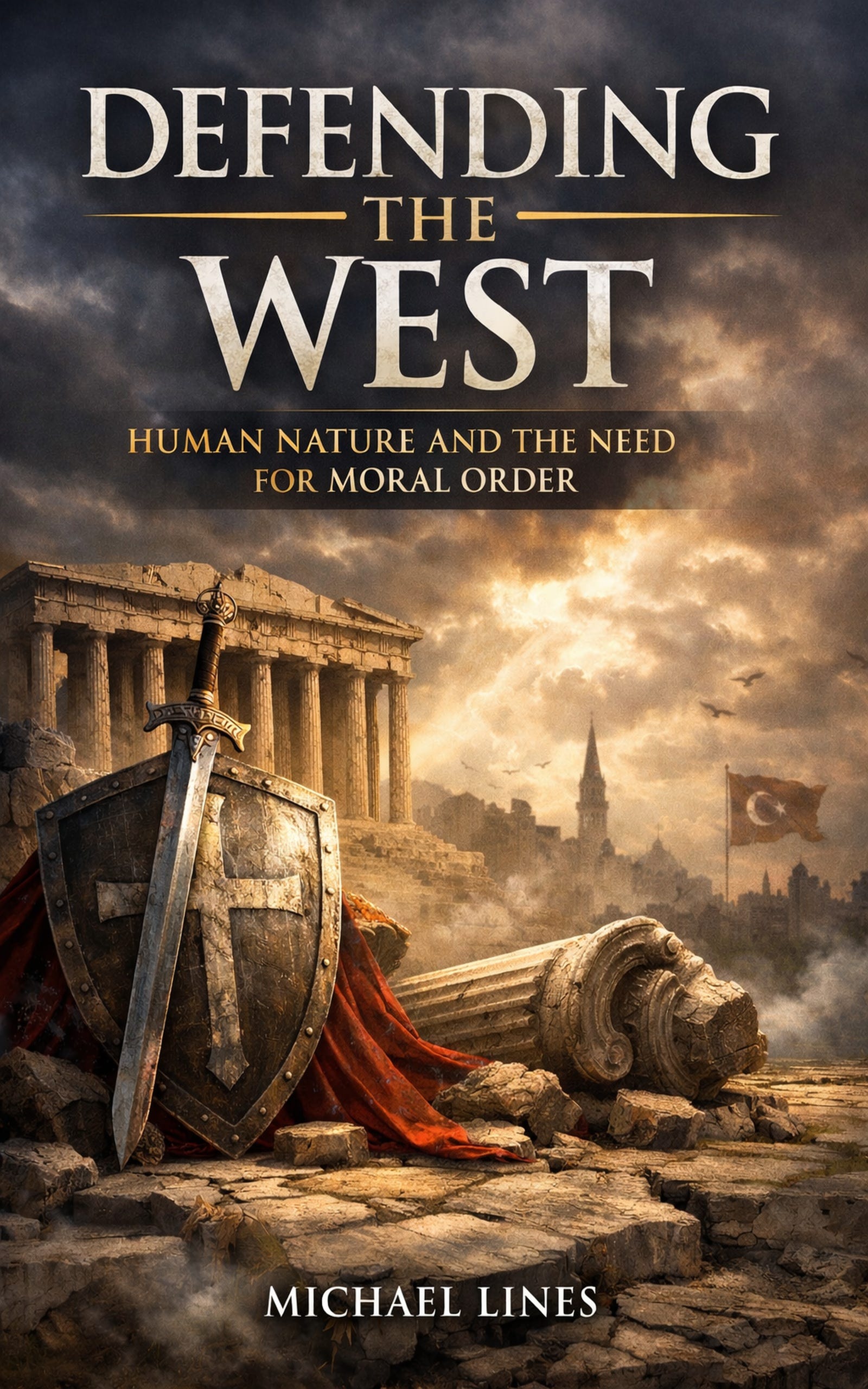
“A house divided against itself cannot stand.”
Matthew 12:25 (KJV)
Religions don’t disappear because they are attacked; they collapse when they forget their core values. In much of the West, mainline Christianity has spent decades trying to gain cultural approval even as its congregations declined. In the name of compassion, its leaders have softened doctrinal teachings; in the name of cultural alignment, they have blurred what were once considered moral absolutes.
Entire denominations now focus more on climate change, diversity efforts, and political activism than on personal sin, repentance, or moral discipline. Language about diversity, equity, and inclusion appears in church statements alongside environmental, social, and governance priorities that look more like corporate initiatives than theological ones. Bishops and clergy openly support positions that conflict directly with historic teachings on sexuality and marriage. The result is not the spread and reinforcement of morality as a shield against evil, but the promotion of evil itself.
The Anglican Communion provides a recent example of this breakdown. Anglican church provinces in Africa and parts of the Global South have broken communion with the main Anglican Church over doctrinal differences related to sexuality and biblical authority. The division is not about messaging; it is about morals. The core issue is whether biblical doctrine or popular culture should guide the Church’s stance on morality. Attendance has declined most sharply in regions like the UK, which have been more willing to change their doctrine to fit modern ideas of what it means to be “good.” When a church reflects society’s morals, it loses its authority to challenge them.
This is not just institutional decline; it is moral appeasement. In trying to avoid offending anyone, moral standards are so watered down that nobody gets offended. To keep members and their donations, the lines between right and wrong become so blurred that they are almost invisible. Yet strength does not come from accommodation; it comes from coherence. When moral clarity is sacrificed in pursuit of popularity, the outcome is neither popularity nor strength but irrelevance.
Against this background, a countertrend has emerged. Orthodox churches and other traditional congregations across Europe and North America—Protestant, Catholic, and Eastern Orthodox—have seen noticeable growth in attendance, especially among younger men seeking structure and discipline. Their appeal lies in moral clarity. Orthodoxy has intentionally avoided modernizing its doctrine to stay aligned with cultural trends. It adheres to biblical teachings on marriage, sexuality, and moral conduct. Its liturgy emphasizes continuity, and its authority structure resists rapid changes to stay in step with shifting trends. While mainline Christianity continues to drift into irrelevance, Orthodoxy affirms the ongoing permanence of biblical doctrine.
The contrast exposes the structural problem confronting Christianity. When moral foundations weaken from within, they create a void of meaning, and as we know, nature abhors a vacuum.
What most in the West fail to understand is that Islam is not just a personal faith but also a comprehensive way of life. Since its origins in the 7th century, its expansion has involved political, military, and religious elements. The movement of Islamic empires into Christian lands, the centuries-long conflict with Byzantium, the Ottoman expansion into Europe from the 14th to the 17th centuries, and the ongoing periods of frontier warfare across Europe all form part of Islam’s historical identity. The fall of the Ottoman Empire after World War I did not end the civilizational tension between Islam and Christianity; it shifted from direct territorial conquest to a strategy of indirect terrorism.
In the twentieth century, some Islamist figures and movements temporarily aligned with the Nazi regime because of their shared hostility toward Jews and Western countries liberalism. In the late twentieth and early twenty-first centuries, several Islamist groups officially adopted terrorism as a form of jihad—originally meaning “struggle in the path of God,” but now, in its militant sense, referring to organized violence and coercion carried out in the name of Islam.
Al-Qaeda’s attack on September 11 was presented as a religious defense of Muslim lands—particularly the Arabian Peninsula—against Western military and political interference. ISIS in Iraq declared a caliphate and killed religious minorities with clear theological justification. Hamas in Gaza openly states its goal of eradicating the Jewish state, as demonstrated in its October 7, 2023, attacks on Israeli concertgoers, which resulted in about 1200 deaths and the taking of 251 hostages.
This violence goes beyond events that make the headlines. In Nigeria, the Islamist groups Boko Haram and ISWAP have targeted Christian communities for years, resulting in tens of thousands killed and millions displaced. Entire villages have been destroyed, with thousands of churches burned and their clergy executed. The pattern is shaped by Islamic doctrine and persists without interruption to this day.
In many Islamic educational settings—from madrassa compounds in Pakistan to Koranic schools in northern Nigeria and Saudi-funded institutions across Europe—children are taught that Islam’s victory is divinely assured and that other religions should only be tolerated in submission. Western liberalism is portrayed as moral decline; Israel and the West are viewed as constant aggressors. Lessons strengthen the divide between believers and non-believers, shaping a worldview that sees Islamic dominance as virtuous and coexistence with other religions as a sign of weakness. Much of this teaching is backed by funding from oil-rich countries that have built networks of schools and mosques across Africa, Europe, and North America.
Islamic migration has brought these tensions to Western cities and countries. Throughout Europe, migrant neighborhoods are enclaves where integration into the existing society is nonexistent, and police are hesitant to enter without backup. In Minnesota and other parts of the United States, rapid demographic changes caused by concentrated Somali communities have created strong cultural tensions, yet people who question these changes are labeled intolerant instead of being recognized as expressing legitimate concerns. The result is a narrowing of public discussion about the risks of Islam’s expansion in the West, as any criticism or debate of it is labeled as racist.
When discussing the risks Islam poses to the West, a common response is that most Muslims are peace-loving and not interested in spreading Islam through violence. This ignores the fact that it’s not how many support a position, but how loudly those who do express their support, which determines its influence.
In any movement, a committed minority can set the agenda if the majority remains passive. If ten percent of a community advocates for a radical cause while ninety percent avoids conflict, that ten percent will steer the course of events. This pattern exists across ideologies; it occurs in Western political parties just as much as in Islam. The question isn’t whether every follower shares the same goals, but which group holds the most influence—and whether any opposition that exists is clear and determined.
Evil, as defined earlier, is the intentional subjugation, exploitation, or destruction of others. When religions justify killing civilians, suppressing dissent, or subordinating other faiths as divine mandates, they cross that line.
The issue isn’t religious convictions themselves, but moral inconsistency. One side softens their beliefs to try and gain greater approval; the other asserts theirs to gain control. One group hesitates to set boundaries; the other clearly defines them. Over time, the movement that sticks to its beliefs more firmly will replace those who constantly seek to dilute theirs. It’s the classic saying: “Give them an inch, and they will take a mile.”
Civilizations are not only displaced by force. They crumble when the internal discipline that helped build them weakens, and external forces face little resistance as they advance their agenda. When shepherds abandon the flock, the wolves will slaughter the sheep.
Copyright © 2026 by Michael Lines. All rights reserved.
The outline of the book Defending the West is available, along with purchase options, at this link.